
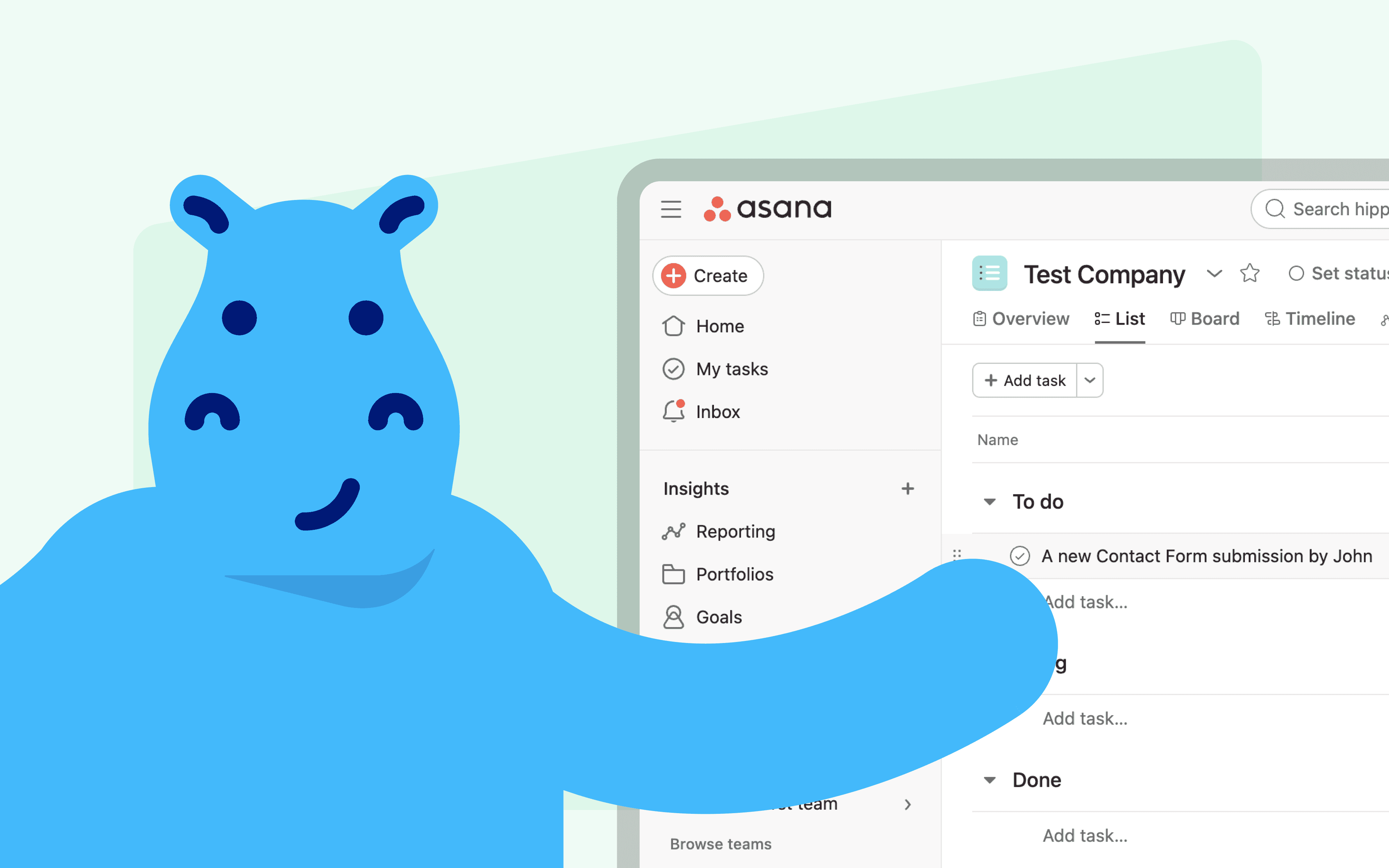
Hipporello turns Asana into a customer-facing ticketing system: portal, form, and email submissions become Asana tasks, your team replies from inside the task, and customer replies stay attached to the same conversation. Customers never need an Asana seat — they work from a branded portal or their inbox while your team works in Asana.
Asana is already a good place to run work. Teams use it to organize requests, assign owners, and push tasks through clear stages with custom fields. Support, IT, HR, marketing intake, and order workflows all fit naturally. The friction shows up before the work reaches the project. A customer emails support@. An employee files an IT request. A client wants a branded place to check status. Asana tracks the task once it exists — but getting structured requests in, and keeping customers in the loop, still needs a dedicated layer. That is the gap Hipporello Service Desk for Asana closes.
Why Asana Teams Need a Service Desk Layer
Asana works well for the team that lives in it. The friction shows up at the edges. Operations and support teams want to stay in Asana because it keeps work focused and visible. Customers and requesters want a simple place to submit, check status, and answer questions — without joining a workspace they do not own. When there is no dedicated intake layer between the two, agents end up copying details from email threads into Asana by hand, and tasks arrive stripped of the context needed to start work.
Support workflow | What usually happens | Impact on the team | Impact on requesters |
|---|---|---|---|
Email-only support | Requests arrive in a shared inbox and are manually rewritten as Asana tasks. | Context is easy to drop, and duplicate work becomes normal. | Requesters often have to follow up to get any update. |
Separate help desk plus Asana | Support agents work in one tool while the rest of the team works in Asana. | Integrations may help, but teams still maintain two systems. | Requesters get ticket updates, but the support context is separated from the actual work. |
Hipporello Service Desk for Asana | Customer submissions create Asana tasks with full context attached. | Teams work from Asana while request details, attachments, and conversation history stay connected to the task. | Requesters use the portal or email instead of entering the Asana workspace. |
Exposing Asana directly to customers is not the aim. Customers stay on a friendly, branded surface, and your team gets a clean, structured queue inside Asana. Keeping the two layers separate protects the focus of your workspace while still giving support a real home.
What Hipporello Adds to Asana
Hipporello is built for teams that want to keep Asana as their system of record while still running a proper ticketing system for customers. It connects to your workspace and creates tasks from customer-submitted forms and incoming support emails, carrying the details that normally get lost in a handoff: form fields, attachments, requester information, and message history.
Hipporello capability | What it adds to an Asana help desk |
|---|---|
Custom-branded portal | Customers get a dedicated place to submit requests, browse knowledge base articles, and track open tickets — with no Asana account needed. |
Forms to Asana tasks | Collect the right fields per workflow — account email, severity, browser, steps to reproduce, screenshots — before the task reaches Asana. |
Emails to Asana tasks | Team inboxes like |
Two-way communication | Reply from inside the Asana task. Customers receive updates by email or portal, and their replies stay attached to the same task. |
Automations | Handle acknowledgments, routing, escalation, SLA-related workflows, and follow-up steps without manual work. |
Analytics and reporting | Track request volume, response times, and team performance across the service desk. |
Knowledge base | Give requesters self-service FAQs and help content from inside the portal. |
Plan details worth knowing before you roll this out: Hipporello's Asana plans include public forms, email intake, unlimited agents, a drag-and-drop form builder, form embedding, inbound email addresses, two-way communication from inside Asana, and canned responses. The Free plan covers the basics and opens with a 14-day Premium trial. Premium is $10 per agent per month and adds automations, custom field support, private forms, and custom notification settings, as detailed on the Hipporello pricing page.
How to Build a Customer Portal for Asana with Hipporello
Setup starts with the decision that shapes everything after: where service requests should land in Asana. You authorize Hipporello, pick the Asana project that should receive service desk tasks, approve the required permissions, and finish configuration in the Hipporello Admin Panel.
1. Choose the Asana Project for Service Requests
A service workflow runs more smoothly when incoming requests have a predictable home. Some teams use a dedicated Asana project for support; others organize by function — Customer Support, IT Help Desk, HR Requests, Marketing Intake. What you want to avoid is dumping customer requests into a general project where ownership is unclear. Hipporello creates tasks in whichever Asana project you choose, so structure it to match how your team actually routes and reports on work.
2. Create Structured Intake Forms
A ticket that says "it is broken" rarely gives the team enough to start on. A better intake flow asks for the right details up front. A bug report form might request the product area, account email, browser, steps to reproduce, expected behavior, actual behavior, and a screenshot. An IT request form asks for device type, location, urgency, and what access is needed. Picture a customer who reports that a button is not working: with a structured form, that arrives as an Asana task with browser, affected feature, and a screenshot already attached — so triage takes minutes instead of three rounds of back-and-forth. Once submitted, Hipporello creates the Asana task with all of that context.
3. Connect Support Email to Asana
Many customers will still reach for email even when a portal exists. Hipporello connects team inboxes so mail to support@, it@, or hr@ becomes an Asana task with the full thread attached. Your team replies from inside the task, and the customer gets the update in whichever channel they started from — no second system to check.
4. Customize the Customer Portal
The portal is the part customers actually see, so it should read like an extension of your product rather than an exposed back-office tool. In Hipporello, customers submit requests, browse knowledge base articles, and track open tickets from a branded interface with your logo, colors, and domain. Some branding options depend on the plan you are on, so confirm the right plan before publishing the portal.
5. Reply from Asana and Close the Loop
Once a request becomes an Asana task, your team handles it where the work already lives. Hipporello keeps the customer conversation tied to that task, so you reply from Asana and the customer gets the update in whichever channel they started — and can answer right there. That is what most teams actually want from a ticketing system: customer communication that stays attached to the task being worked, not a second inbox to babysit.
FAQ: Asana Ticketing System and Customer Portal
Can Asana be used as a ticketing system?
Asana can track support-related work as tasks inside projects. Hipporello adds the ticketing system layer around it: a branded portal, structured forms, email intake, two-way requester communication, automations, reporting, and a knowledge base — all wired to Asana tasks.
Can customers submit tickets to Asana without an Asana account?
Yes. With Hipporello, customers and other non-Asana users submit through a portal, forms, or email. Hipporello creates the matching Asana task, and the requester keeps using the portal or email instead of joining your workspace.
Can support emails become Asana tasks?
Yes. Hipporello connects team inboxes so addresses like support@, it@, or hr@ create Asana tasks and keep the requester conversation attached to each task.
Can my team reply to customers from Asana?
Yes. Teams reply from within the Asana task. Customers receive updates by email or in the portal, and their replies sync back into the same conversation on the task.
Does Hipporello support a branded customer portal for Asana?
Yes. Hipporello provides a custom-branded portal with logo, colors, domain, and layout options. Customers submit and track requests without needing an Asana seat.
Is Hipporello only for customer support teams?
No. It covers customer support, IT help desks, HR request management, marketing intake, order processing, and operations workflows. The same portal, form, email, and Asana task workflow adapts to whichever team is using it.
Turn Asana into a Customer-Ready Ticketing System
Support breaks down when customer conversations live in one place and the actual work lives somewhere else. Hipporello connects those layers without forcing customers into Asana or pushing your team into a separate ticketing tool — submissions become Asana tasks, and your team manages the work and replies without leaving Asana.
Ready to connect customer requests to Asana? Start with Hipporello Service Desk for Asana, or install it from the Asana App Directory.
Table of Contents


